
3 Closing the Gap
-
3 Closing the Gap
-

 Ich kann ...
- ... Entwicklungsprojekte von (über)staatlichen Organisationen gegenüber Hilfsaktionen nicht-staatlicher Akteure (NGOs) abgrenzen.
- ... die Rolle von staatlichen Akteuren in der Entwicklungshilfe erläutern und deren Einfluss auf die Umsetzung von Entwicklungsprojekten analysieren.
- ... die Rolle von Nichtregierungsorganisationen (NGOs) in der Entwicklungshilfe beschreiben und deren Ansatz zur Förderung von nachhaltiger Entwicklung erläutern.
- ... Beispiele für NGO-Programme und staatliche Entwicklungsprojekte nennen und deren Herangehensweise untersuchen.
- ... die Vor- und Nachteile (nicht-) staatlicher Entwicklungszusammenarbeit diskutieren.
- ... Entwicklungsprojekte hinsichtlich ihrer Zielsetzung und ihres Beitrags zur nachhaltigen Entwicklung bewerten.
- ... meine eigene Meinung zur Entwicklungspolitik entwickeln.
- ... über Karikaturen und Fotos sprechen und in einen Kontext einordnen.
- ... mit einem Flyer Informationen strukturiert und zielgerichtet präsentieren / in Interviewform ein Thema vorstellen.
-
Intro: Development cooperation by (non-) governmental actors - Real Solutions or just a Band-Aid?



M1 The heavy burden M2 Volunteers collecting donations for an NGO
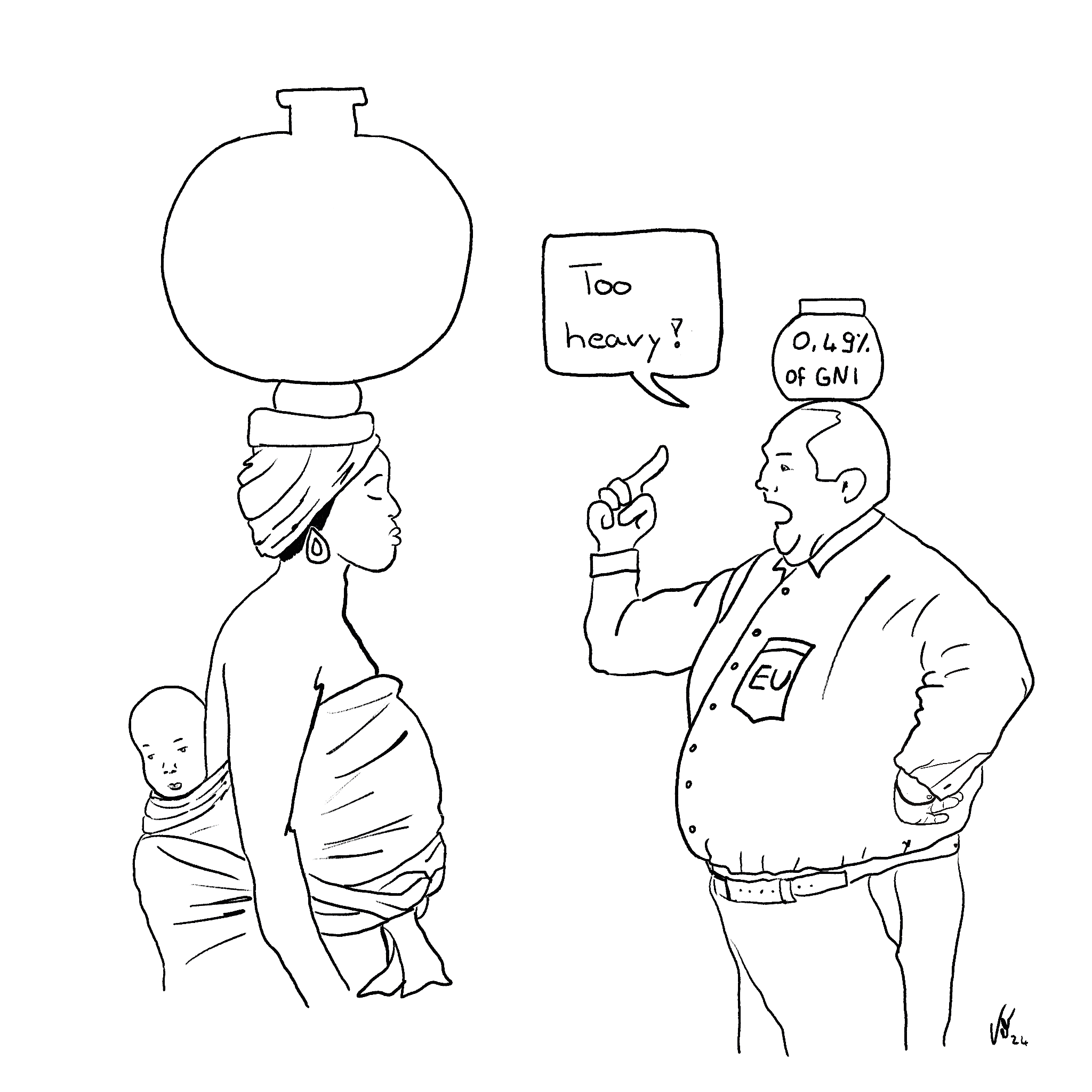

cartoon: Dorothea Kelm foto: Unsplash+

1. Choose one material and describe to your partner what you can see. What kind of development aid is presented?
Take a closer look at the cartoon. What might be the woman´s burden? Fill the vessel on her head with words. If you're stuck for ideas, you can use the image slider to get some inspiration.
Discuss with a partner: What might be the woman´s burden in the cartoon M1? Fill the vessel on her head with words. Present your "vessel of words" in class.
2. Compare the type of development assistance by the European Union with the help provided by NGOs.

Discuss the advantages and disadvantages of (non-) governmental development assistance.
-
Task: Aid in Action - Exploring real-world examples of development cooperation




1 In small groups, select a development cooperation project that interests you personally, either from the BMZ's Transparenzportal or from an NGO of your choice.
2 Analyze this development cooperation project you have chosen using the analysis matrix and evaluate the development cooperation project.
3 Create a flyer in which you visualize your results.
 Leave your flyer in the student folder.


Prepare an interview in which you present your chosen project. Here you find further instructions.
Leave the audio with your interview in the student folder.Discussion and Reflection

Discuss in class the different types of aid and examples presented.
-
- What type of aid seemed most effective and why?
- What were some common challenges faced in the examples?
- How do these real-world examples compare to theoretical knowledge?
 If you don't have any ideas, take a look at the UN development aid project Millennium Villages Project. The successes and failures are impressively described and analyzed in the following Spiegel articles:
Uno-Millennium-Dörfer in Tansania: Was bleibt von den Millionen? - DER SPIEGEL
-
-
Reflexion: Take a stand


 Position yourself on the target.
("agree" in the middle, "rather not" on the outside)
Thesis 1: To lift people out of poverty worldwide
industrialized countries must increase their
funds for development cooperation
greatly.
Thesis 2: There is no point in sending Western development
because development cannot be achieved from outside. The people
on the ground must ensure the development of their country.
Thesis 3: The causes of poverty in the developing
countries lie primarily in the
behavior of the industrialized countries. They must
first change their own behavior before they can
demand reforms from the developing countries.
Thesis 4: Development cooperation harms
people in developing countries more
than it helps them. It should therefore be
abolished as soon as possible.
-